zaterdag 19 november 2016

Hey, Silicon Valley

18 okt 2016. WIRED
Hey Silicon Valley: President Obama Has a To-Do List for You
From the contribution of Tim O'Reilly:
"This all may sound obvious, but far too little of the tech industry operates this way today. We’ve gotten to a point where companies aren’t even trying to build a business that will produce profits; they are just trying to stay funded long enough for another company to acquire them. They are actively chasing the waste instead of the win. That misplaced focus isn’t just annoying, it contributes to global inequality, because it emphasizes capturing value instead of creating it. It reminds me of Wall Street in 2007. 
And it echoes the story of the economy writ large. Over the past 30 years, wages have largely flatlined as corporate profits have surged, which means that companies in other sectors too are capturing more wealth than they are creating. This is a recipe for economic stagnation. Consumer demand is 70 percent of GDP. So when companies treat people solely as an expense to be automated away, or as mere supply of wealth to be extracted, they are slowly cutting their own throats."

vrijdag 18 november 2016

Wie betaalt wat?


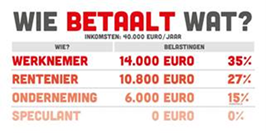
Linx+, de culturele afdeling van het ABVV - en dus het ABVV - verspreidt dezer dagen een tabel met een rake vergelijking van de belastingvoet voor hetzelfde inkomen dat op verschillende wijze werd gegenereerd. De sociale onrechtvaardigheid is onmiddellijk duidelijk.

Ik beperk mij hier tot een eerste, intuïtieve reactie en dat is de volgende: niet de verschillen in de belastingvoeten zijn belangrijk, maar wel a) hoeveel procent van de brutowinst naar werknemers gaat (loonaandeel toegevoegde waarde), b) hoe efficiënt de staat werkt (ratio output tegenover overheidsbeslag).

Waarom is de verdeling op zich niet belangrijk? Eenvoudigweg omdat het een boekhoudkundige zaak is: men kan de werknemersbijdrage voor de sociale zekerheid ook meteen verrekenen bij de werkgever, en dan zou de belastingdruk zich naar dat niveau verplaatsen.

Waarom is het wél belangrijk welk aandeel van de brutowinst werknemers krijgen: vooreerst omdat ze het spenderen (wat BTW oplevert), daarnaast omdat het niet vlucht zoals ander kapitaal en dus gemakkelijk belast kan worden (zie punt 1).

De efficiëntie van de staat bepaalt ten slotte wat de werkelijke belastingdruk is. Neem zorg of onderwijs als voorbeeld. Dit kan privaat of door de overheid worden voorzien. Als de staat goedkoper werkt, bijvoorbeeld door haar natuurlijk monopolie, dan de privé-sector, dan kan men niet spreken van een hoge belastingdruk. Als de staat daarentegen de verkeerde investeringen maakt, met het mandaat van de kiezer, dan moet de kiezer zijn keuze in vraag stellen. Het grootste probleem is echter wanneer de kiezer baat heeft bij een inefficiënte staat, bijvoorbeeld als ambtenaar, of als ondernemer in het irreguliere circuit.

zondag 6 november 2016

Zero marginal costs

There is an interesting phenomenon on its way which we do not fully understand yet. It's the computer revolution. Now many observer believe that the second machine age is like the first, that technology has always been seen as a threat but in hindsight created more work and welfare. I do not buy that for a number of reasons.

First, the simple stat is flawed. Yes, more people work and there is more welfare, but there are also many more people living on earth compared with the middle ages. We do not have precise observations, but it is not unlikely that the majority of the people before the industrial revolution were all working full time, regardless of age and sex. So the machines may have enhanced the labour force, and freed up time for leisure for most, but some are unlucky not to have the skills that suit a machine. In order to let them accept the introduction of technology, we should therefore always distribute welfare, also to those who have made room for progress.

Second, in this machine age, I believe we are heading towards a point were the very human aspect of labour, not its force, but its knowledge, is being substituted by computers. That is very different, because it excludes complementarity of capital and labour to a much larger extent. For now, this leads to job polarization, but soon software may take over more advanced tasks which have now fairly big gains, and robots might take over many service jobs that require a 'human touch'.

Third, the apologists say fear is not needed as the past predicts the future and we've sorted it out last time. I believe that is the wrong motivation. Fear is not needed, indeed, but not because nothing is going to change, but because it is possible to see a change for the better. Why, after all, would we want to work? We don't, that's why we ask a wage in return for the trade of leisure. For those who think this will lead to a demographic boom, maybe not: if we spend more time caring about individuals, we have a new constraint other than the price of education: the time which we cannot multiply. Also, procreation brings responsabilities, which we may want to keep under control.

Fourth, I tend to agree with Paul Mason that there will be a change of system. The steam machine introduced capitalism. After all, those machine are capital that allows the making of profits, of which part goes to the worker and the rest to the shareholder. The new technology works autonomous, which will actually take away profit. We tend to think of companies that adopt technology as labour-killers, but what they really are is profit-killers. The beauty of capitalism is that companies will always want to be the first to go on that road, because then profits actually increase. As soon as one more company follows, we have Bertrand competition that drives prices to zero, because software (the new capital) produces its goods and services at zero marginal costs. I thought of this a while back, and others have without a doubt too, but Paul Mason found a really interesting note of Karl Marx who predicted exactly this, and it is entirely in line with marxist economics. If labour becomes obsolete, there is no more income and no more turnover. So it is a system changer. Now before we yahoo about this, nobody knows what the new system will be. It is possible that we distribute according to needs, or based on a basic income scheme equally for all. It is also possible that capital holders will manage to protect intellectual right on software and intangible products (like a song or a movie), and have ordinary people sweat to obtain it without actually contributing much to society. Amongst capitalists, there will then be a fair amount of trade, owning brands and intellectual rights, and forming cartels much like today, while those who were former workers will then be slaves. Personally I think the latter scenario is most likely, even if it relies on reducing democracy. It is probably even already ongoing.

So in sum, there will be a change and it could be for the better or worse, depending on whether you catalogue more equality as the former or the latter. It certainly deserves a debate.

zondag 10 april 2016

EU28 Member States in seven clusters

It's a very repetitive task to always cluster European Union Members States, but despite the heterogeneity in any possible group of clusters, it is probably the only way to have a basis for comparison.

My preferred clusters consist of the EU-15 and the New Member States, or Central and Eastern Europe. Within each group, we can further split up by broad welfare state or cultural groups. The syntax below for Stata should be self-explanatory.

gene byte eu28 = 0
replace   eu28 = 1 if inlist(geo,"BE","DE","FR","AT","NL")  // Continental Western Europe
replace   eu28 = 2 if inlist(geo,"GB","IE")     // British isles
replace   eu28 = 3 if inlist(geo,"SE","FI","NO","DK")     // Scandinavia
replace   eu28 = 4 if inlist(geo,"ES","IT","PT","GR")     // Southern Europe
replace   eu28 = 5 if inlist(geo,"HU","PL","SI","SK","CZ")  // CEE Slavic (and Hungary)
replace   eu28 = 6 if inlist(geo,"LT","LV","EE")            // CEE Baltic
replace   eu28 = 7 if inlist(geo,"HR","RO","BG","CY","MT")  // CEE Balkan and Mediterranean Isles

vrijdag 23 oktober 2015

Stata float detail

Beware, Stata may be the most comfy and reliable software for STATistical Analysis, but it sucks in comparison with your handheld calculator if you want to come up with the simplest of figures. Why? Because computers do not see 0.1 as we do (decimal issue), and because there is a trade off between precision and speed or efficient storage (rounding issue).

Below is an experiment to show the second issue. Make three variables with long numerics, store them as float, double, and default. As there are more then 7 digits of precision, the float variable will be rounded.

clear
set obs 1
gene float  varfloat = 2567987654 
gene double vardouble = 2567987654
gene vardefault         = 2567987654

gene float varfloatchange = 10
replace varfloatchange   = 2567987654
format * %15.0f
list

     +---------------------------------------------------+
     |   varfloat    vardouble   vardefault   varfloat~e |
     |---------------------------------------------------|
  1. | 2567987712   2567987654   2567987712   2567987712 |
     +---------------------------------------------------+

As you can see, the default type was float, an Stata did not store any float variable with the same precision as the input. Instead, we have another figure, which happens to be 2567987712 for no apparent reason. It's not random, because if you rerun the syntax it is always the same. Probably it is some rounded exponentiated figure or the closest figure obtainable in a binary series of 7 digits or so.


donderdag 22 oktober 2015

Stata code for Herfindahl concentration index

Herfindahl concentration index

The Herfindahl concentration index computes a score between 0 (total dispersion) and 1 (total concentration) which is the sum of all squared shares within a unit.

In the working example hours per job for workers are used.

tempvar t1
egen `t1' = total(hours), by(workerid year)
tempvar t2
gene `t2' = (hours / `t1')^2
egen herfindahl = total(`t2'), by(workerid year)
drop `t1' `t2'
label var herfindahl "Herfindahl concentration index"

maandag 21 september 2015

Strongly balanced sample (Stata simulation)

clear
local base = 4      /* Set nr. of observations per units */
local size = 200    /* Set nr. of units */

*****
local tot = `size' + `base' - 1
di `tot'
set obs `tot'
gene id = floor(_n / `base')
gene time = `base'*(_n/`base' - id) + 1
drop if _n < `base'

*****
xtset id time